Archive | Egypt

Tags: , , , , , ,

Egyptian Pyramids at Giza – Aren’t In The Middle Of Nowhere

Posted on 14 December 2009 by anthony

You’d have to be living under a rock to not know that the Giza Pyramids are in Egypt.

What I found most striking about Giza wasn’t the pyramids themselves, but just how much Cairo suburbia encroached onto the pharaoh’s place of permanent rest.

giza pyramids Egyptian Pyramids at Giza   Arent In The Middle Of Nowhere

Judging by the numerous clichéd photos of Giza showing three pointy edifices surrounded by endless sand, I’d always assumed the Pyramids were located in an isolated section of the Sahara, not as an almost token mausoleum part of Cairo’s outskirts.

Here’s the proof:  This is the view looking out from the Giza Pyramids.

cairo skyline Egyptian Pyramids at Giza   Arent In The Middle Of Nowhere

The travel brochure photographers obviously used the correct angles ensuring grimy slums don’t spoil the ridiculous tributes to the pharaohs.

Or the photos were 20 years old.

Or both.

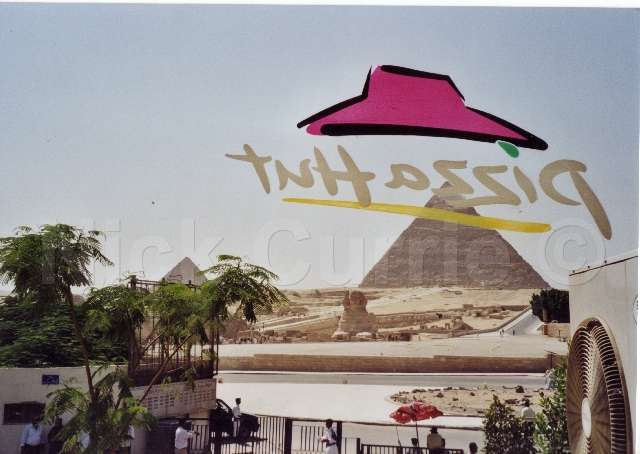
But as a final photograph of proof, here is a painfully obvious photo of how much the Giza Pyramids have turned into a Tourist Trap:

Egyptian Pyramids Giza Pizza Hut The Travel Tart

There you go!

If you haven’t yet visited the Egyptian Pyramids at Giza, sorry for spoiling your image of them!

  • Share/Bookmark

Comments (9)

Tags: , , , , , , , , ,

Egyptian Pyramids – What Do They Look Like Inside?

Posted on 28 May 2009 by anthony

Egyptian Pyramids - one of the biggest travel cliches in the world.  However, they are still impressive.  Most people know about the Giza Pyramids, located on the outskirts of Cairo.  While one has to pay to enter the pyramid of Cheops at Giza, his old man’s pyramid further down the road at Memphis  is much better value (that is, free) since it is lesser known in the world of the three dimensional triangles.

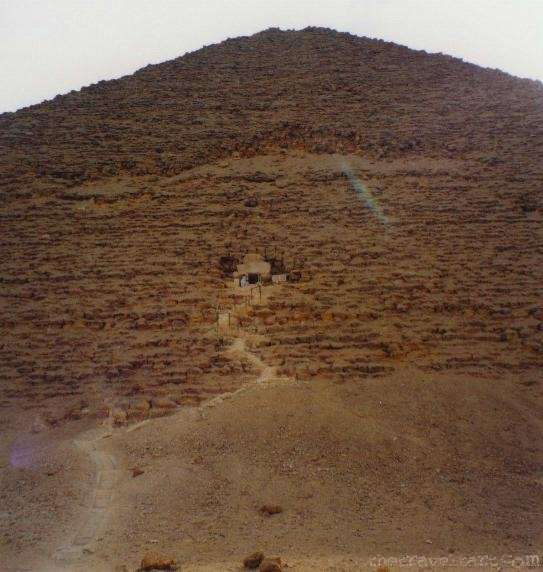
When I visited in 2002, I was quite happy that the cheap-arse option worked in my favour for once. However, my calves were cursing my travel addiction, as the long trek towards the pyramids’ heart involved transcending a tunnel that dipped at an angle of 45 degrees, and was only about 120 centimetres high.  The outside of the pyramid is shown below.

pyramid entry point Egyptian Pyramids   What Do They Look Like Inside?

This gymnastic performance required a body metamorphosis that made me acquire a bent neck and Quasimodo-like back. I was also concerned that the pyramid entrance ‘guards’ had insisted on me ‘renting’ their torches for ‘safety reasons’ – even though a constant trail of fluorescent lighting had produced a glare almost half as much as the standard 7-11 store.

After spending time inside a pyramid, I could understand why some conspiracy theorists think they were built by aliens. The precision of the pyramid blocks was astounding. Looking up from inside the chamber,  each block was perfectly interlocked with the other, and no sign of degradation was visible.

Have a look inside this Egyptian Pyramid below.

inside pyramid Egyptian Pyramids   What Do They Look Like Inside?

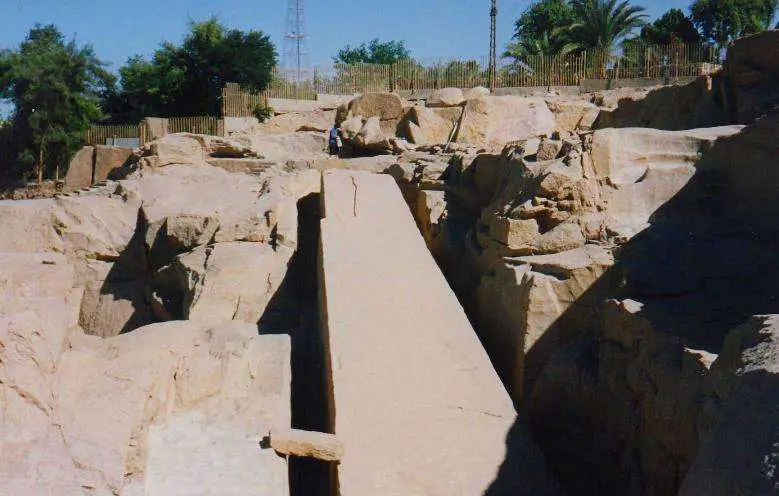
Other things to do in Egypt – go for a Camel Ride, visit Abu Simbel and the Unfinished Obelisk.

Whilst simple, this structure would have been a structural engineers’ delight.  So there is today’s lesson on Egyptian Pyramids.

  • Share/Bookmark

Comments (3)

Tags: , , , , , , , ,

Abu Simbel, Egypt – An Impressive Piece of Legoland

Posted on 04 May 2009 by anthony

The Abu Simbel temples are located near the Egypt/Sudan border, only a few hours ride in a suicidal mini-bus taxi.  They were ordered by the king of all pharoahs, Pharaoh Ramses II.

He must have been an egotistical bugger, as the sole purpose of Abu Simbel was to demonstrate his power and his divine nature to all who sailed the Nile.

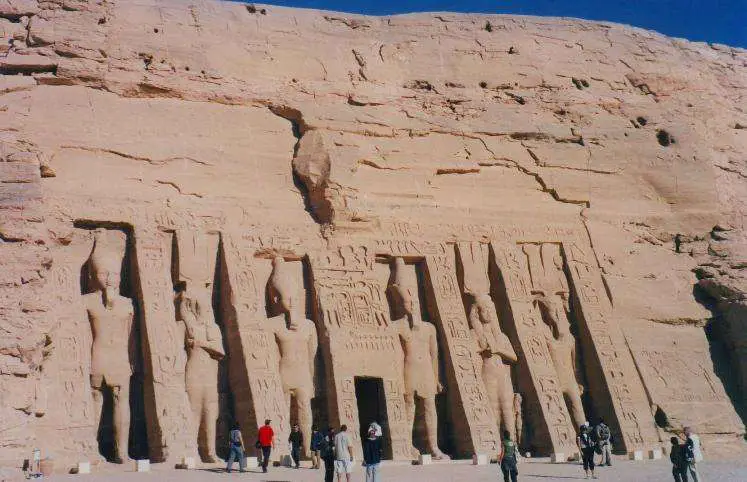
This is clearly verified by the four colossal 20 metre-high statues of himself flanking the entrance, obviously outshining any silly portraits of current-day tycoons sitting in lavish mansion foyers.

Abu Simbel is shown below:

abu simbel Abu Simbel, Egypt   An Impressive Piece of Legoland

However, not even Ramses II is immune from progress.  The temples were cut from their low-lying rock faces and shifted to higher ground in the 1960s, as the water of Lake Nasser rose following completion of the Aswan High Dam - a project that was funded by the Soviet Union.

The transformation of Abu Simbel to higher ground was probably a greater engineering feat than the construction of the Dam itself.

The temple was cut into equal-size blocks and moved by any transport available and reassembled Lego-style.  If you go there, a grainy black and white video at the visitor’s centre will outline the rising waters almost overtopping the makeshift bund that was hastily erected.  However, the Abu Simbel Lego set was dismantled and reassembled in time, before it started resembling an ancient history water theme park.

Whilst the Aswan Dam was a fine example of Soviet Union one upmanship against the Americans, they failed submerging Abu Simbel before it was relocated, unlike later attempts regarding their submarine fleet.

I hoped their dam engineering expertise was better than the experience employed in their Ukrainian nuclear reactors – otherwise, a catastrophic dam failure would have created an instant large wave where one could surf a battered felucca all the way to Cairo and the Mediterranean Sea.

While in Egypt, you can visit the Unfinished Obelisk and go on a camel ride at the Pyramids once you have visited Abu Simbel.

  • Share/Bookmark

Comments (1)

Tags: , , , , , , , ,

Wanna Camel Ride? The Hard Evidence

Posted on 18 March 2009 by anthony

Taking photos of the Giza Pyramids in Egypt.  It’s a nightmare at the best of times.  Usually, the place is crawling with all sorts of tourists and wannabe tourist guides, offering all sorts of things such as a Camel Ride.

It’s virtually impossible to take a photo of the Pyramids without people in the frame.  Photoshop becomes a useful tool sometimes when it comes to tarting up Pyramid images.

However, here is some photographic evidence of how difficult it is to keep people out of shot.

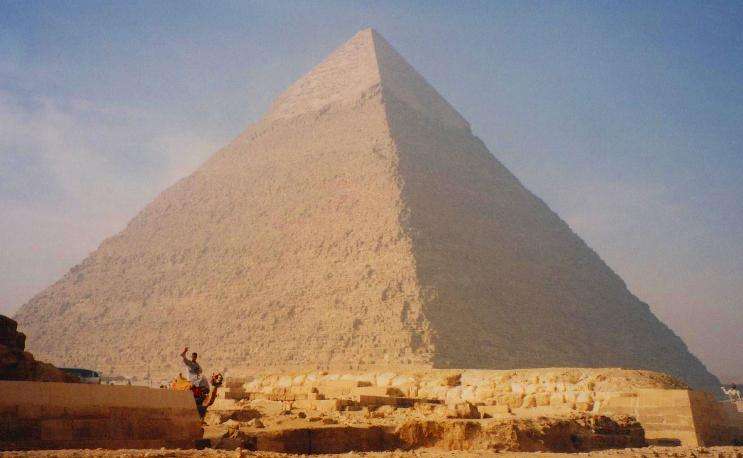
It’s one of the locals hailing me down, wanting to know if I wanted to sit on a smelly, farting camel for a cruise around the Pyramids on a Camel Ride.  I couldn’t see him until it was too late, and I had already pressed the shutter.

After I had refused the offer of a Camel Ride, this enterprising individual then wanted payment for having him in my photo when I didn’t want him there in the first place.

He was dreaming!

want camel ride Wanna Camel Ride? The Hard Evidence

If you’re still interested in Camel Rides, check out Camels, Skulls, and Cobras: A Wild Ride Across India.

  • Share/Bookmark

Comments (2)

Tags: , , , , , , , , , , , ,

Worst Drivers In The World

Posted on 16 March 2009 by anthony

Worst Drivers In The World.

I’ve travelled a lot around the world – my country counter is now over 30.

One thing I’ve noticed throughout my travels is that the quality of driving around the world varies considerably.

I’ve devised my own award for the Worst Drivers In The World – the Juan Manuel Fangio Award for Outstanding Defensive Driving.

Let me explain about the Worst Drivers In The World.

minibus taxi Worst Drivers In The World

Worst Drivers In The World: Case Study Number One: Italian Drivers
I have a theory – the amount of religious paraphernalia on a car’s rear view mirror is a reliable indicator of how crap the drivers are. The more crucifixes, rosary beads, or evil eyes wrapped around the mirror, the more dangerous the driving is. I first tested this theory in Italy.

By heritage, I am half Sicilian and half Northern Italian. A visit to Italia was a home-coming of sorts for me, even though I’d never been here before in a physical sense. However, my first encounter with my Italian heritage was to be – the traffic.

The city of Rome was my first exposure to the chaotic Latino driving that was the bane of the Italian stereotype: the roads are an extension of the Monza Formula One race track. Collisions result from a reckless apathy for traffic laws and from gawking at gorgeous women walking down the street. Merging is a competition, not a mutual effort; road signs and traffic lights are merely ornamentation. Moped riders manoeuvre in ways that I would not attempt on a Play Station.

Drivers will tailgate, wildly waving their hands as if to signify an emergency. I thought maybe Italians were fearful of being late for the latest christening, hot date or lunch at mama and papas. I concluded that they simply enjoyed dicing with death for kicks.

Italy’s rating on the Worst Drivers Index (out of 10) – 7.

Worst Drivers In The World: Case Study Number Two: Egyptian Taxis
Here is some advice – one should refuse to enter a Cairo taxi, even if one really needs to. I’m not sure what side of the road these taxis drive on, because they use the ENTIRE road. From this harrowing experience, I have devised my own facts about Cairo taxis:

- My previous stated theory that high volumes of religious paraphernalia = bad driving was indeed confirmed once again – Egyptian taxis seemed to have enough evil eyes and prayer beads to reduce the car’s centre of gravity below the potholed tarmac;

- A high number of car dents or bent panels is an indication that someone is looking after the taxi driver;

- It’s a lineball decision to leave ones’ nose inside or outside of the taxi – your nose will be wiped out by either a collision with another taxi, or by the drivers’ nose-hair-singing body odour;

- Pedestrians must give way to taxis at all times and locations, even at zebra crossings and when the green-man light is on; and

- Seat belts are optional, unworkable or not available.

Egypt’s rating on the Worst Drivers Index – 9.5.

Worst Drivers In The World: Case Study Number Three: Minibus Taxis in Zimbabwe
My favourite of the Worst Drivers! Ever tried working out the logic of waiting four hours for a minibus taxi, for it to blast onto a neglected highway system at the speed of sound for an 11 hour journey sitting next to a person with the biggest backside in the world? Me neither.

On a trip to Zimbabwe, I arrived at Bulawayo Train Station at eight o’clock on a Sunday morning after an overnight trip from Victoria Falls. I wandered around the grimy streets asking for the presence of the bus station. After discovering that no bus offices were open that day, it frightfully dawned on me there was only one option to return to South Africa that day – the dreaded mini-bus taxi.

I had previously seen mini-bus taxis everywhere in Africa, but never had the privilege of being transported within one. Mini-bus taxis seem to work on the principle of not leaving the car park until they are full, to maximise the income gained per seat per trip. This wait may last from four minutes to four hours, or possibly even four days – probably insignificant in African time terms.

I heard horror stories about these taxis – the vast majority of them are clapped-out pieces of corrosion that would not pass a roadworthy at a demolition derby. The best story was where a driver had replaced the worn steering-wheel by attaching two plumbing wrenches on the column instead. However, this was my (relatively) lucky day. After the driver had graciously accepted my money, I only waited for a grand total of four hours for the mini-bus to depart the Bulawayo bitumen. A steady trickle of people would arrive at the mini-bus to pay their money and use their luggage as a makeshift bed, while waiting for the signal to leave.

At midday, the mini-bus had reached its quota (that is, three times the legal carrying capacity of the vehicle) and left the car park. It was from this point where I was abruptly introduced to the rather absurd four/one forty rule – waiting four hours for the mini-bus to fill up in the car park, only for this lost time to be compensated by screaming along the woefully under-resourced Zimbabwean Highway system at the top speed of 140 kilometres per hour. I concluded that Africa does not need a Grand Prix as there is enough high speed action on its highways.

The mini-bus taxi may as well have been a suicidal Mitsubishi Zero, ready to honourably take out a pylon of a precisely targeted overpass. What added to the mini-bus thrill theme ride was that I’d miserably lost the dreadful game of mini-bus musical chairs – I’d managed to pick the seat next to the person with the largest arse on the mini-bus, and possibly, southern Africa. She was a large woman who seemed friendly enough. She did not communicate with me in words – but instead with various facial expressions. She tried her best to make room for me from her window seat, but when combined with my arse, it was inevitable that one of my butt cheeks would pathetically lose out. I still have the mental and physical scars of that trip – especially the one dissecting my right butt cheek.

During this doomed trip, I had thought Johannesburg was probably not the most ideal place to scramble for suitable accommodation at an estimated arrival time of midnight. At the Zimbabwe/South African border post at Beitbridge, I had arranged beds (note, plural) for myself and another minibus taxi journeyman, a Belgian man called Jan, at a Pretoria backpackers. I noticed that my recently purchased South African phone card displayed the helpful advice of ‘Don’t Cut Your Lifeline’ complete with pictures of a public phone handset and a set of open bolt cutters. Since my lifeline was not yet broken, I received an assurance from the Backpackers that they would wait for us until we arrived. Once I had finished drinking a gut-rotting Coke out of an ingeniously marketed AfriCAN, it was time to brace myself for another supersonic test ride.

However, after continuing his kamikaze mission for another few hours, the mini-bus driver probably had another mini-bus taxi car park that was more important than mine and had completely bypassed Pretoria and was on the way to Johannesburg. After informing the death wish pilot, he exited the freeway at the midway suburb of Centurion and we said our humble goodbyes at the nearby service station. This may have sounded uneventful, but I received an eerie feeling when I spotted the ‘Hijacking Hotspot’ advisory sign at the top of the exit ramp.

In an unconvincingly reassuring voice, I said to Jan ‘It mustn’t be THAT bad – the Hijacking Hotspot sign hasn’t been hijacked yet!’

We called a less suicidal taxi and managed to reach Pretoria without being hijacked, where we pleaded for the Backpackers to let us in at midnight. To our delight, a muddled voice answered on the intercom and a buzzer sounded to release the thick steel bar security gates.

We were stuffed and there was only a queen bed available in the entire hostel. After 12 hours on the Victoria Falls train, four hours lounging on backpacks in a hot Bulawayo mini bus taxi car park, and 11 hours on the mini-bus, I did not give a rats. The bed was the most comfort I had encountered in days, and it didn’t matter who I shared it with. I was quite prepared to endure an unconscious man-hug from Jan at three o’clock in the morning if I had to, but I really needed to sleep. After washing off the slimy African grime from the previous two days, we both crashed in an exhausted slump, grateful to still be alive.

The minibus taxi rating on the Worst Drivers Index – 11.

In conclusion, Worst Drivers In The World are one of the joys of travelling, and are part of the authentic travel experience. Just make sure your life insurance is up to date and of a considerable amount!

Ironically, you can get a mug and Sweatshirt about The Worst Drivers In The World.

This was posted on the Road Junky site, as part of their travel writing competition shortlist in January 2009.

Related Posts with Thumbnails
  • Share/Bookmark

Comments (4)

Photos from our Flickr stream

See all photos

Copy Protected by Chetan's WP-CopyProtect.