Today in ANZAC Day – a national holiday in Australia and New Zealand.
Gallipoli is probably modern Australia’s most spiritual European history place, even though it’s not in Australia.
I won’t go into the history of this battle (you can read more about it here), but the leader of the Ottoman forces, Mustafa Kemal Atatürk, almost single-handedly won it for the Ottomans.
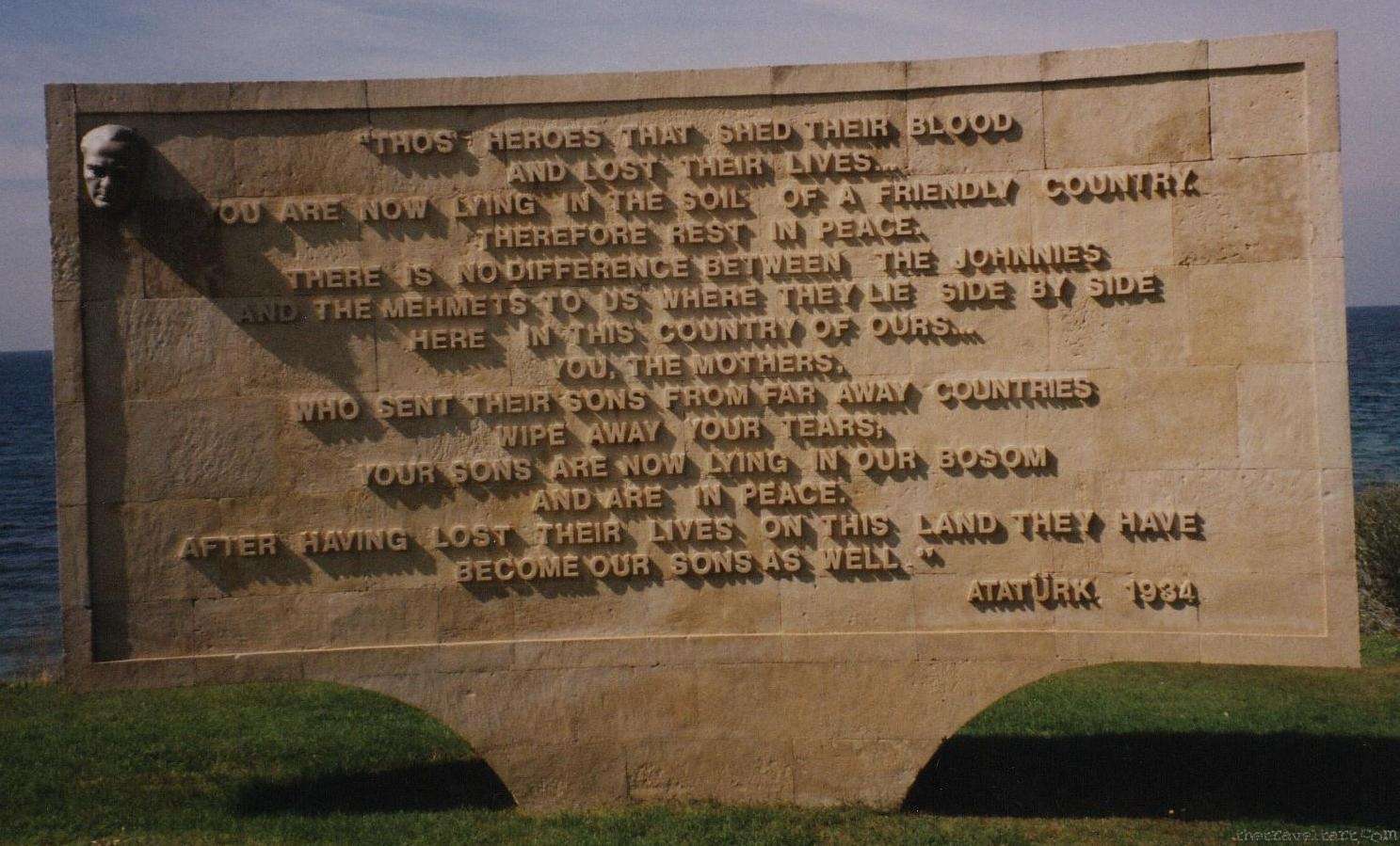
There’s a picture of Atatürk in every shop and home in Turkey. Anyway, he later became Turkey’s first President, and said the following famous words after he met relatives of a lost ANZAC solider who visited the site in the 1930s.
Remember, these words came from a former enemy.

Most travellers know this – the best way to learn about a historical event it to actually visit the place where a momentous event happened. And this is especially so with visiting the Gallipoli Peninsula.
And you don’t have to visit on Anzac Day either to appreciate it.
The Gallipoli museum is a real jaw-dropper – some of the exhibits highlight just how futile war is, such as bullets pierced by other bullets in mid air, skulls of soldiers shattered by shrapnel, and a bullet-shell cake formed from expended shells that had fallen into the mud.
I found John Simpson Kirkpatrick’s grave especially understated – the man who transported injured and barely alive soldiers from the frontline to safety on his trusty donkey(s), only to be killed by wayward shrapnel himself.
His tombstone was a non-descript one located within hundreds of others, and emblazoned with the words ‘John Simpson Kirkpatrick served as 202 Private J. Simpson, Aust. Army Medical Corps. 19 May 1915, Age 22. He gave his life that others may live.’
The most moving part of the Gallipoli visit was undoubtedly Lone Pine (or Bombasirti). Thousands of Australian and New Zealand lost lives were inscribed on the memorial. But thousands of Turks also lost their lives here.
I’ll leave the rest of this post up to Atatürk.
These words are never forgotten by those who visit Gallipoli, especially on Anzac Day.
‘The events that took place at Bombasirti, 14th May 1915 are incomparable in military history. The distance between the trenches was approximately eight meters, meaning death was certain. All the men in the first row of the trenches fell, no one was saved. Their places were immediately taken by men from the second row of trenches. Do you know how calm and resigned to his fate the solider was? His calmness would be the envy of others. He saw the others dying under raining bombs, shrapnel and bullets and he also knew that he was going to die in three minutes – but he didn’t hesitate. Mustafa Kemal.’
To read about ANZAC Day in more details, see 25 April 1915: The Day the Anzac Legend was Born.